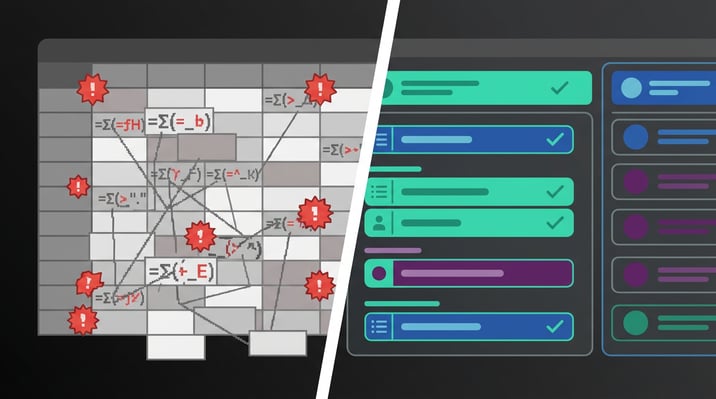
If your agency is still tracking commissions in spreadsheets, you are not alone. A lot of health insurance agencies start there. The problem is most of them stay there too long, and by the time they realize it, the errors, the hours, and the agent disputes have already added up.
This page breaks down commission management software vs. spreadsheets for health insurance agencies: what each approach actually handles, where each one breaks down, and how to know when it is time to make a change.
What is Commission Management Software?
Commission management software is a platform built to automate, organize, and distribute commission payouts across your agency's downline. For health insurance agencies, that means processing carrier statements, calculating split payouts by agent or hierarchy level, generating agent-facing statements, and giving leadership visibility into what is moving in and out.
Comissio is built specifically for Accident and Health agencies. It handles carrier statement processing, downline payout distribution, agent-level visibility controls, and white-labeled statements, without requiring a manual step every pay cycle.
What Most Agencies Use Spreadsheets For
Spreadsheets work well at the start. When you have a small book of business, a handful of agents, and one or two carriers, a spreadsheet can get the job done.
Here is what agencies typically track in spreadsheets:
- Carrier payment totals by month
- Agent commission splits
- Chargeback adjustments
- Retro corrections
- Payout records by period
The issue is not the spreadsheet itself. The issue is what happens when any of those variables multiply.
Comissio vs. Spreadsheets: Side-by-Side Comparison
Spreadsheets work well at the start. When you have a small book of business, a handful of agents, and one or two carriers, a spreadsheet can get the job done.
Here is what agencies typically track in spreadsheets:
- Carrier payment totals by month
- Agent commission splits
- Chargeback adjustments
- Retro corrections
- Payout records by period
The issue is not the spreadsheet itself. The issue is what happens when any of those variables multiply.
| Feature | Spreadsheets | Comissio |
|---|---|---|
| Carrier statement processing | Manual data entry | AI-powered, carrier-specific |
| Downline payout calculations | Manual formulas | Automated by hierarchy |
| Agent-level visibility | None (or manual exports) | Built-in agent portal |
| White-labeled statements | Not possible | Logo applied across platform |
| Error detection | Caught after the fact | Flagged during processing |
| Audit trail | Version history only | Full change log by record |
| Scalability | Breaks with growth | Built to scale |
| Admin fee offsetting | Not applicable | Admin fees can offset platform cost |
| Time per pay cycle | Hours | Significantly reduced |
| Agent dispute resolution | Manual research | Traceable by statement line |
Where Spreadsheets Break Down for Health Insurance Agencies
1. One carrier check, dozens of agent payouts
Most health insurance agencies receive a single commission check from each carrier. From there, your team has to calculate what each agent in your downline is owed, accounting for splits, tiers, adjustments, and any policy-level changes from that period.
In a spreadsheet, that calculation is manual every time. One formula error, one missed chargeback, one retro adjustment applied to the wrong row, and your payout is wrong before it goes out.
2. Carrier statement formats vary
Carriers do not send statements in a standard format. One comes as a PDF, another as a CSV, another as a web portal export. Your team has to normalize all of that data before you can even start calculating payouts.
At scale, that normalization process alone can take hours per pay cycle. And it is entirely human-dependent, which means it is also error-dependent.
3. Agents cannot see their own data
A spreadsheet has no agent portal. When an agent calls to ask why their payout changed, your team has to pull the file, find the record, trace the adjustment, and explain it manually. Every time.
That is not a minor inefficiency. For agencies with 20, 50, or 100+ agents in their downline, it is a recurring operational drain that compounds over every pay cycle.
4. Leadership has no real-time view
Spreadsheets are snapshots. By the time leadership looks at a commission report, the data is already stale. There is no live view of what is pending, what was paid, what was flagged, or where an agent dispute stands.
That becomes a problem fast when agency growth puts pressure on operations.
5. It does not scale
A spreadsheet that works for 10 agents does not work for 40. The formulas get more complex, the files get larger, the version control breaks down, and the person who built it becomes a single point of failure. When they leave, take a vacation, or get sick, the whole process stalls.
What Comissio Handles That Spreadsheets Cannot
Automated downline distribution Once a carrier payment comes in, Comissio calculates each agent's payout based on your hierarchy and split rules. No manual formulas. No rounding errors. No missed adjustments.
Agent portal with white labeling Agents log in and see their own statements. Your agency's logo is on the platform, the agent portal, and the statements. Disputes drop because agents have answers before they call.
Admin fee management Agencies can apply admin fees within the platform. For many agencies, those fees offset the cost of the platform itself, making the switch cost-neutral or better.
Built for A&H, not P&C Comissio is built specifically for Accident and Health commission structures. It is not a general-purpose commission tool adapted for insurance. The logic, the workflows, and the features are built around how A&H agencies actually operate.
When Should Your Agency Stop Using Spreadsheets?
You do not have to wait until something breaks. But here are the signs that most agencies recognize in hindsight:
- Your team spends more than a few hours per pay cycle on commission calculations
- Agent payout disputes are a recurring conversation
- You have experienced at least one significant calculation error
- Leadership cannot answer basic commission questions without pulling a file
- You have hired or plan to hire more agents and your current process does not flex
- The person who manages your spreadsheet is the only one who fully understands it
If two or more of those are true, you are past the point where a spreadsheet is the right tool.
The Real Cost of Staying in Spreadsheets
The cost of commission management software is visible. The cost of spreadsheets is not, which is exactly why agencies stay in them too long.
Here is what manual tracking actually costs:
- Staff hours spent on data entry, normalization, and error correction
- Leadership time spent investigating disputes
- Agent trust when payouts are wrong or unexplained
- Growth capacity lost to a process that cannot scale
- Risk exposure when audit trails are incomplete
For most agencies, those costs exceed the cost of a purpose-built platform long before they are ever measured.
Frequently Asked Questions
Is commission management software worth it for smaller agencies? It depends on your growth trajectory. If you have 15 or more agents in your downline and you are growing, the time and error costs of spreadsheet tracking typically exceed platform costs within the first year.
Does Comissio work for agencies that receive one carrier check and pay multiple agents? Yes. That is Comissio's core use case. The platform is built around the single-check-to-downline-distribution model that most A&H agencies operate on.
What is the difference between commission management software and reconciliation tools? Commission management software handles the calculation, distribution, and visibility of commission payouts. Comissio focuses specifically on commission management for A&H agencies and does not include a reconciliation feature.
Can agents see their own commission statements in Comissio? Yes. Agents have their own portal where they can view their statements. The portal and statements carry your agency's branding, not Comissio's.
Does Comissio handle chargebacks and retro adjustments? Yes. Adjustments are tracked at the statement level and visible to both agency admins and agents, which reduces the number of disputes that require manual explanation.
How does Comissio process carrier statements? Comissio uses AI-powered processing built around each carrier's specific statement format. The goal is accuracy at the carrier level, not a generic import process applied across all carriers the same way.
What happens to my current spreadsheet data when I switch? Your team works with Comissio during onboarding to migrate historical data and configure your hierarchy and split rules. You do not start from zero.
Bottom Line
Spreadsheets are not a bad starting point. They are a bad long-term solution for agencies managing complex downline commission structures.
If your team is spending hours per pay cycle on calculations, fielding agent disputes, or running on a process that one person built and only one person understands, that is the signal.
Commission management software does not just save time. It gives your agents clarity, gives your leadership visibility, and gives your operations room to grow.
.gif)